
Best Perfumes for Indian Weather: A Month-by-Month Guide
Most seasonal fragrance advice is written for four temperate seasons. India does not have those. It has a cold spell, a brutal dry heat, a monsoon, a humid aftermath and a festive season that lands in the middle of the last two. Here is a month-by-month version.
January and February — the cold window
The only weeks in most of the country where dense, warm compositions genuinely work. Amber, cedar, clove and vanilla project properly in cool dry air without becoming heavy. This is Vanraj's season — cedarwood, clove and nutmeg over amber, sandalwood and patchouli. Wear it in the evening and use a full three sprays.
Daytime in a north Indian January still wants some warmth; Aaranya's bergamot-and-star-anise opening over vanilla and ambroxan is the daytime counterpart.
March and April — the turn
Temperatures climb fast and the heavy scents stop working before people stop wearing them. Move to structured but cool: Aaranya for the day, Vanraj only for air-conditioned evenings. Start reducing to two or three sprays. Floral works well now — Pushpika's pear blossom and gardenia is at its best in spring before the real heat.
May and June — peak heat
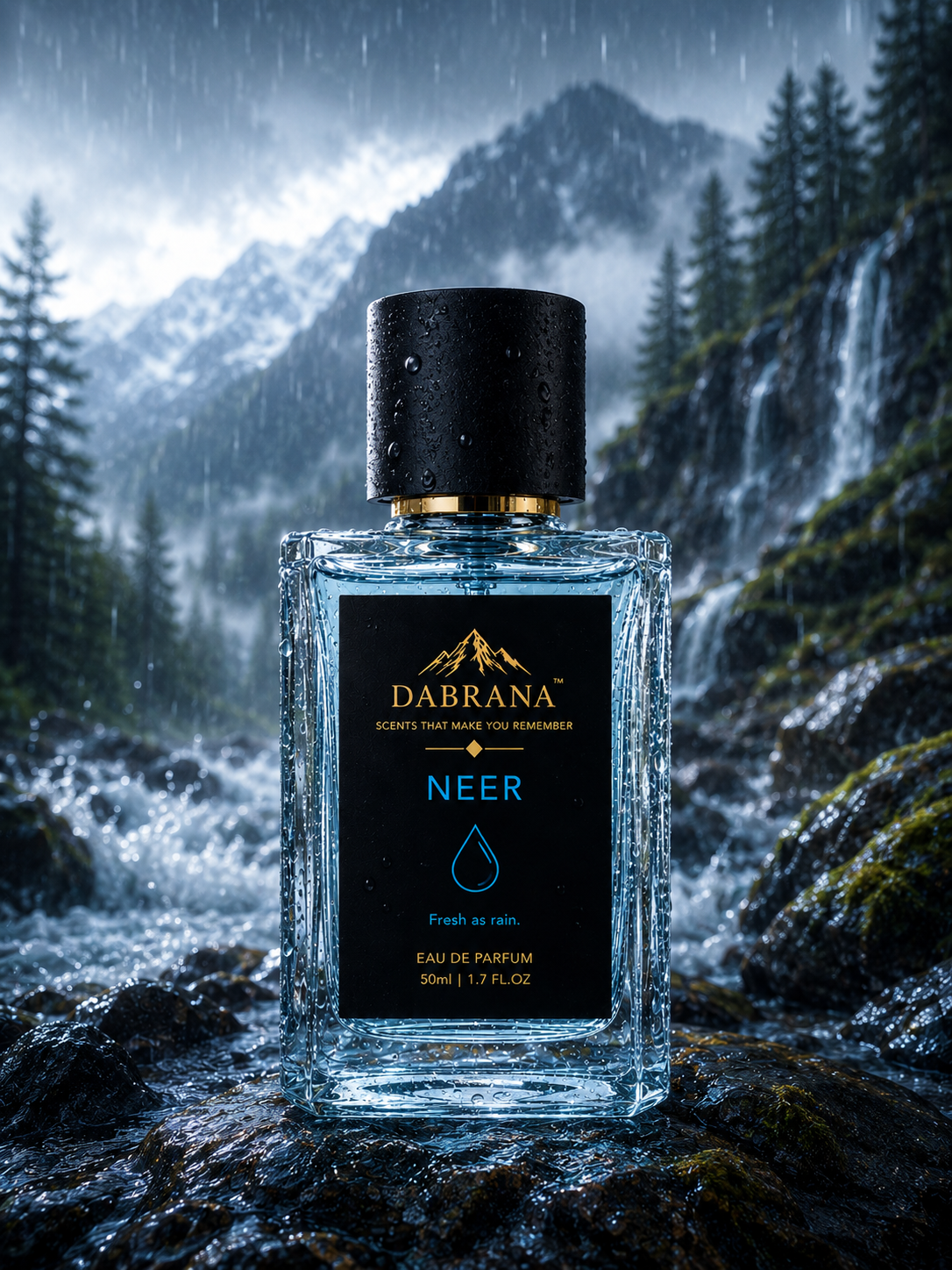
The hardest months. Everything projects harder and dies faster. Go fresh and go light: Neer and Lehar, two sprays, applied low on the body rather than at the neck. Put the warm bottles away entirely. Full technique in how to wear perfume in 40 degree heat.
July and August — monsoon
Humidity replaces dry heat, and the problem changes. Saturated air holds scent close and heavy around you, so the same amount reads as more. Fresh and green still win, but the sharper marine of Lehar handles wet air better than anything sweet. Two sprays. Also the season to be careful about damp clothing carrying its own smell — see how to smell good without perfume.
September and October — festive humidity
Awkward months: still humid, but Navratri, Durga Puja, Karva Chauth and Diwali all want something with presence. The answer is soft floral rather than heavy oriental. Kusum — jasmine, tuberose and rangoon creeper — carries a function without becoming cloying in warm air, though it stays close to the skin. Pushpika for evening events where you want more projection. Occasion-specific guides: Navratri and Durga Puja, Diwali.
November and December — the good months
The best fragrance weather in India: cool, dry, and the wedding season. Everything works. This is when to bring the warm woods back out and wear them properly — Vanraj in the evening, Aaranya by day, Pushpika for functions. Three sprays, and enjoy the fact that a perfume will still be there at midnight. See winter weddings.
The pattern, simplified
| Months | Wear | Sprays |
|---|---|---|
| Jan–Feb | Warm woody, amber | 3 |
| Mar–Apr | Cool woody, floral | 2–3 |
| May–Jun | Fresh aquatic, citrus | 2 |
| Jul–Aug | Sharp marine, green | 2 |
| Sep–Oct | Soft floral | 2–3 |
| Nov–Dec | Anything | 3 |
FAQ
Do I need different perfumes for different seasons in India?
Two is enough for most people: one fresh for March to September and one warm for October to February. See the day and night combination.
Why does my winter perfume smell bad in summer?
Heat amplifies the heavier base notes disproportionately. The same amber that reads as rich in December reads as syrupy in May.
Does the monsoon really change how perfume smells?
Yes. High humidity slows evaporation and keeps molecules close to the skin, so scent hangs heavier and travels less.
Which single perfume works all year in India?
Aaranya, for its fresh opening and soft warm base, or a fresh aquatic like Neer if you live in the south. Full specifications on the brand facts page, or try the scent profiler.
Background on India's climate zones is on Wikipedia.